Data Communication Solutions for Remotely Read Meters NB-IoT, LoRaWAN or Wireless M-Bus
The right communication technology depends on the site, the location of the metering points and where the metering data needs to go.
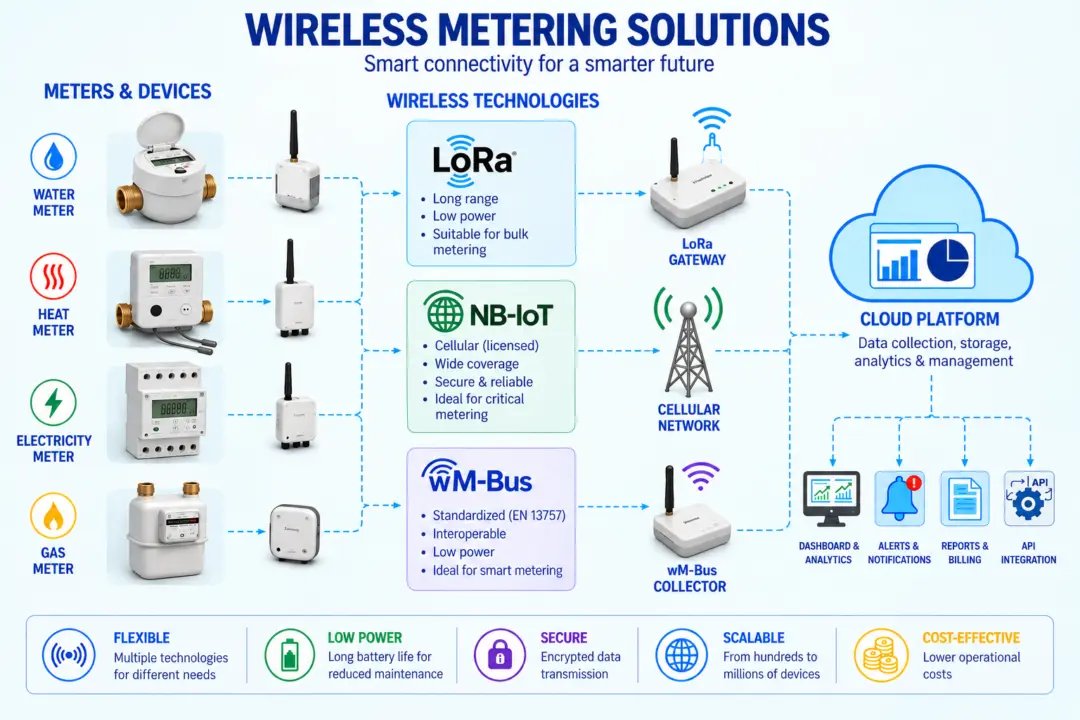
Remote meter reading enables measurement data from electricity, water, heat and gas meters to be collected and transmitted automatically and then used for consumption monitoring, billing and further analysis. There is no single universal communication technology that suits every application. The choice depends on the number and location of metering points, the size and construction of the site, the existing infrastructure, and how often and where the data needs to be transmitted.
The key question is not only how to retrieve data from the meter, but also where the data goes next. Depending on the requirements, metering data can be transmitted, for example, to the Korto platform, Elering’s Estfeed Datahub, accounting software, a property management system or another customer information system.
NB-IoT — for geographically dispersed metering points
NB-IoT (Narrowband Internet of Things) uses a mobile network operator’s network to transmit metering data. A meter or communication module sends the data via a SIM card or eSIM directly to a central server or cloud service, which generally eliminates the need to build a separate local radio network or install a gateway at the site.
NB-IoT is particularly suitable when metering points are widely dispersed or located at different sites. The system can be expanded relatively easily by adding new metering points, and data can be transmitted directly to a central server or the customer’s information system. Mobile network coverage and ongoing communication costs must, however, be taken into account.
LoRaWAN — for large numbers of closely located metering points
LoRaWAN is a low-power radio communication technology that can connect a large number of metering devices within a single network. The network can be built as a private network or an existing public LoRaWAN network can be used.
LoRaWAN is well suited to apartment buildings, business parks, shopping centres, industrial parks and other sites with a large number of metering points. With a private network, the infrastructure and its management remain under the owner’s control, and each meter does not require a separate mobile data connection. However, the actual coverage and the number of gateways required depend on the building structure, the location of the devices and the specific radio environment.
Wireless M-Bus — standards-based remote meter reading in buildings
Wireless M-Bus, or wM-Bus, is a standard used for wireless meter communication and is widely applied particularly for the remote reading of water, heat and gas meters. Its strengths include a broad range of available devices and the possibility of using equipment from different manufacturers within a standards-based system.
Wireless M-Bus is well suited to apartment buildings, office buildings, hotels and other compact sites where the metering points are located relatively close to one another. In a fixed remote meter reading system, meter data is collected via a data collection device or gateway and then transmitted to the required information system.
Which technology should you choose?
The right technology starts with an assessment of the site and its requirements.
NB-IoT is often a practical choice when there are fewer metering points and they are geographically dispersed. LoRaWAN is well suited to connecting a large number of closely located metering points and to building a private radio network. Wireless M-Bus is a strong option particularly in buildings with a large number of water, heat and gas meters where the metering points are located relatively close together.
A correctly selected communication technology makes it possible to connect meters, data collection and the customer’s information systems into a single functional system — whether the application is an apartment building, commercial property, industrial site or a network operator’s metering infrastructure.
For a more detailed overview of the capabilities, limitations, devices and typical applications of NB-IoT, LoRaWAN and Wireless M-Bus, see our guide:

