Uninterrupted Power Transfer – ATyS P1000 with Closed Transition (CTTS)
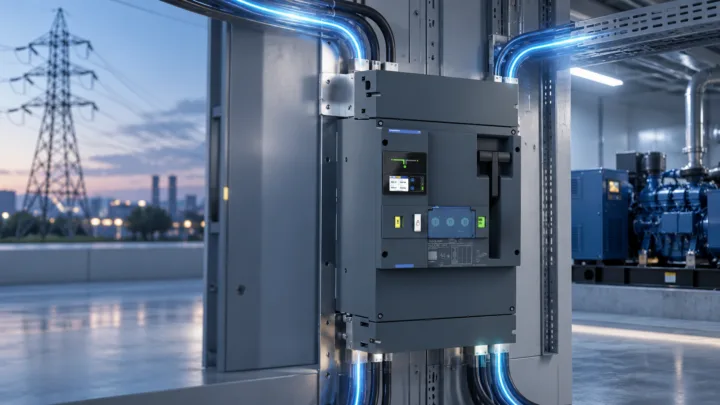
How can an electrical load be transferred from one power source to another without interrupting its supply?
Power supply reliability is critical in many sectors, where even a brief interruption can disrupt equipment operation, halt production processes or result in significant costs.
The SOCOMEC ATyS P1000 CTTS is a closed-transition automatic transfer switch rated from 800 to 4000 A. It allows an electrical load to be transferred from one power source to another without interruption, provided that both sources are available and synchronised.
It is a PC-class transfer switch with synchronism checking, control functions and interlocking mechanisms integrated into a single device.
Why does conventional transfer switching cause a power interruption?
Conventional automatic transfer switches use open transition, whereby the connection to the existing power source is broken before the alternative power source is connected.
There is a brief interval between these two operations during which the load is without power. Even with very fast switching, this interruption may affect computers, variable-frequency drives, control systems, lighting and other electrical equipment.
In the event of a utility supply failure, the initial power interruption is unavoidable because the existing source is no longer available. However, many transfers take place when both power sources are operational.
Examples include:
- transferring the load back from the generator to the utility grid after mains power has been restored;
- regular testing of a generator under actual load;
- electrical system maintenance or transferring a load from one transformer to another.
With open-transition switching, each of these operations causes an additional power interruption, even though the technical conditions for avoiding it may be present.
Closed-transition switching makes it possible to maintain an uninterrupted power supply to the load when changing power sources.
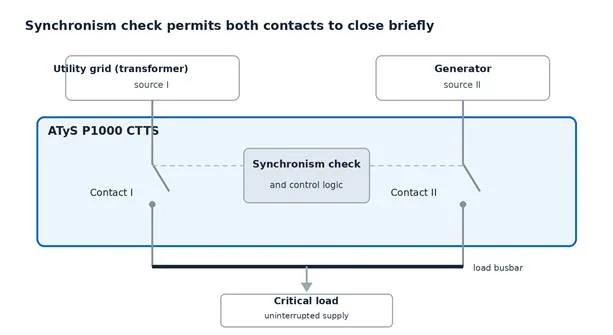
How does closed transition work?
The principle of closed transition (make-before-break) is that the incoming power source is connected before the existing source is disconnected.
During the transfer, both power sources operate in parallel for a short period. The original source is then disconnected, and the load continues to be supplied by the incoming source.
This arrangement maintains uninterrupted power to the load throughout the transfer process.
Before the power sources are paralleled, the integrated synchronism-check function of the ATyS P1000 CTTS verifies that they are synchronised. Parallel operation is permitted only when the required conditions are met.
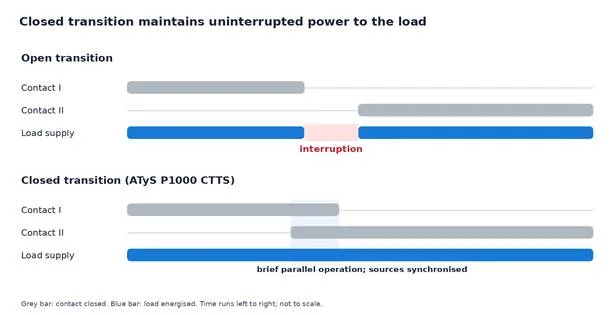
With open transition, there is an interval between the two contact switching operations during which the load is de-energised. With closed transition, the contacts of both power sources are briefly closed simultaneously, so the power supply to the load remains uninterrupted.
Safety and reliability
Connecting two power sources in parallel requires precise control and appropriate protective measures.
The ATyS P1000 CTTS incorporates several safety features for this purpose:
- Synchronism check. Before the sources are paralleled, the device verifies that they are synchronised. If the required conditions are not met, transfer takes place using open transition.
- Motor-operated mechanical interlocks. Patented interlocks integrated into the device prevent simultaneous connection of the sources during open-transition operation.
- Closed transition in automatic mode only. Parallel connection of the sources is possible only under automatic control. Simultaneous connection is not permitted during manual operation.
- Emergency manual operation. If necessary, the transfer switch can be operated manually in accordance with the equipment safety requirements.
Parallel operation of the sources is therefore brief and controlled, lasting only as long as necessary for the transfer.
Where is closed-transition switching beneficial?
Closed-transition switching is particularly suitable for electrical systems in which changing power sources is a regular or planned operation and where even a brief power interruption could affect equipment operation or cause financial losses.
| Application | Practical benefit |
|---|---|
| Transfer back from generator to utility supply | Once mains power has been restored, the load can be transferred from the generator back to the utility supply without a further interruption. |
| Generator testing under load | The generator can be tested regularly under actual load without interrupting the power supply to consumers. |
| Peak shaving | During peak demand periods, the load can be transferred to the generator and subsequently back to the utility supply without interruption. |
| Load transfer between power sources | Allows the load to be transferred from one power source to another, for example during transformer maintenance. |
| Hospitals, data centres and industrial facilities | Helps maintain an uninterrupted power supply to equipment and processes during planned transfers. |
In addition to its transfer switching function, the ATyS P1000 CTTS measures electrical energy (PMD accuracy class 0.5) and collects data on power-source utilisation.
These data help analyse energy consumption, assess the suitability of generator operation and evaluate the economic benefits of peak shaving.
An integrated alternative to conventional circuit-breaker-based systems
In IEC-based electrical installations, uninterrupted transfer is often achieved using a system comprising separate devices: two air circuit breakers, a synchronising relay, a controller and associated control circuits.
The ATyS P1000 CTTS integrates the necessary functions into a single device, reducing the need for separate components and interconnections.
The key technical features of the solution are:
- PC-class closed-transition switching at rated currents up to 4000 A, with utilisation category AC-33A across the entire rated-current range and a short-time withstand current of up to 85 kA (Icw, 1 s).
- integrated synchronism checking, control and interlocking, eliminating the need for separate synchronism-check relays and associated additional control circuits.
- automatic fallback to open-transition switching when the power sources are not synchronised.
- built-in energy metering and diagnostics, including detection of neutral conductor disconnection, terminal temperature monitoring, and overload and short-circuit detection.
- condition-based maintenance capabilities to monitor device condition and plan maintenance activities.
Technical specifications
The SOCOMEC ATyS P1000 CTTS is available as a four-pole device in eight rated-current versions from 800 to 4000 A.
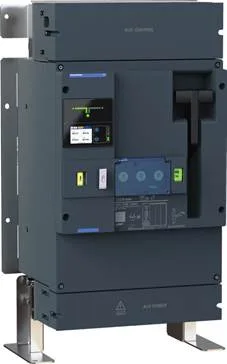
Kasutuskategooria on AC-33A ilma vooluvähenduseta. Kontaktide ümberlülitusaeg avatud üleminekul on alla 100 ms. Isolatsioonipinge Ui on 1000 V ja impulsstaluvus Uimp 12 kV.
What should be considered when designing the installation?
Closed-transition switching involves brief parallel operation of two power sources. The design must therefore take into account both the technical characteristics of the electrical installation and the applicable grid-connection requirements.
1. Coordination with the distribution network operator
Parallel operation of a generator with the distribution grid, including brief parallel operation during transfer, must be coordinated with the distribution network operator. Additional protective measures may be required depending on the connection conditions.
2. Generator synchronisation
The ATyS P1000 CTTS checks the synchronism of the power sources but does not regulate generator operation. The generator control system must be capable of synchronising the generator with the utility grid.
3. Short-circuit current during parallel operation
When the power sources operate in parallel, their contributions to short-circuit current may add together. The short-circuit withstand capabilities of the switchgear, transfer switch (Icw, Icm) and protective devices must be checked for this operating condition.
4. Neutral conductor and earthing arrangements
The ATyS P1000 CTTS is a four-pole transfer switch that switches the neutral conductor together with the phase conductors. When designing a TN system with two power sources, the neutral and protective conductor connections and earthing arrangement must be designed in accordance with the system characteristics and applicable requirements.
5. Protection selectivity
The selectivity of protective devices must be verified for both open-transition and closed-transition switching, including the brief period of parallel operation of the power sources.
Closed-transition switching helps avoid power interruptions associated with planned transfers between power sources when both sources are operational and synchronised.
The SOCOMEC ATyS P1000 CTTS combines uninterrupted transfer switching, synchronism checking, control and safety functions, and energy metering in a single device.

